

INSTITUTION CREATES A CASE
A compliance officer flags a transaction requiring documentation. Compliance-RFI instantly creates a case and writes it to the Polygon blockchain — timestamped, immutable, and uniquely identified.

Every cross-border payment that triggers a compliance review generates a Request for Information. Correspondent banks issue them. Regulators expect them. Compliance teams spend hours managing them — through email threads, PDF attachments, and manual follow-up calls.

A compliance officer flags a transaction requiring documentation. Compliance-RFI instantly creates a case and writes it to the Polygon blockchain — timestamped, immutable, and uniquely identified.

The customer receives a unique access link and 6-digit code. They upload supporting documents — invoices, contracts, identity proofs — through the encrypted portal. Every submission is logged on-chain the moment it arrives.

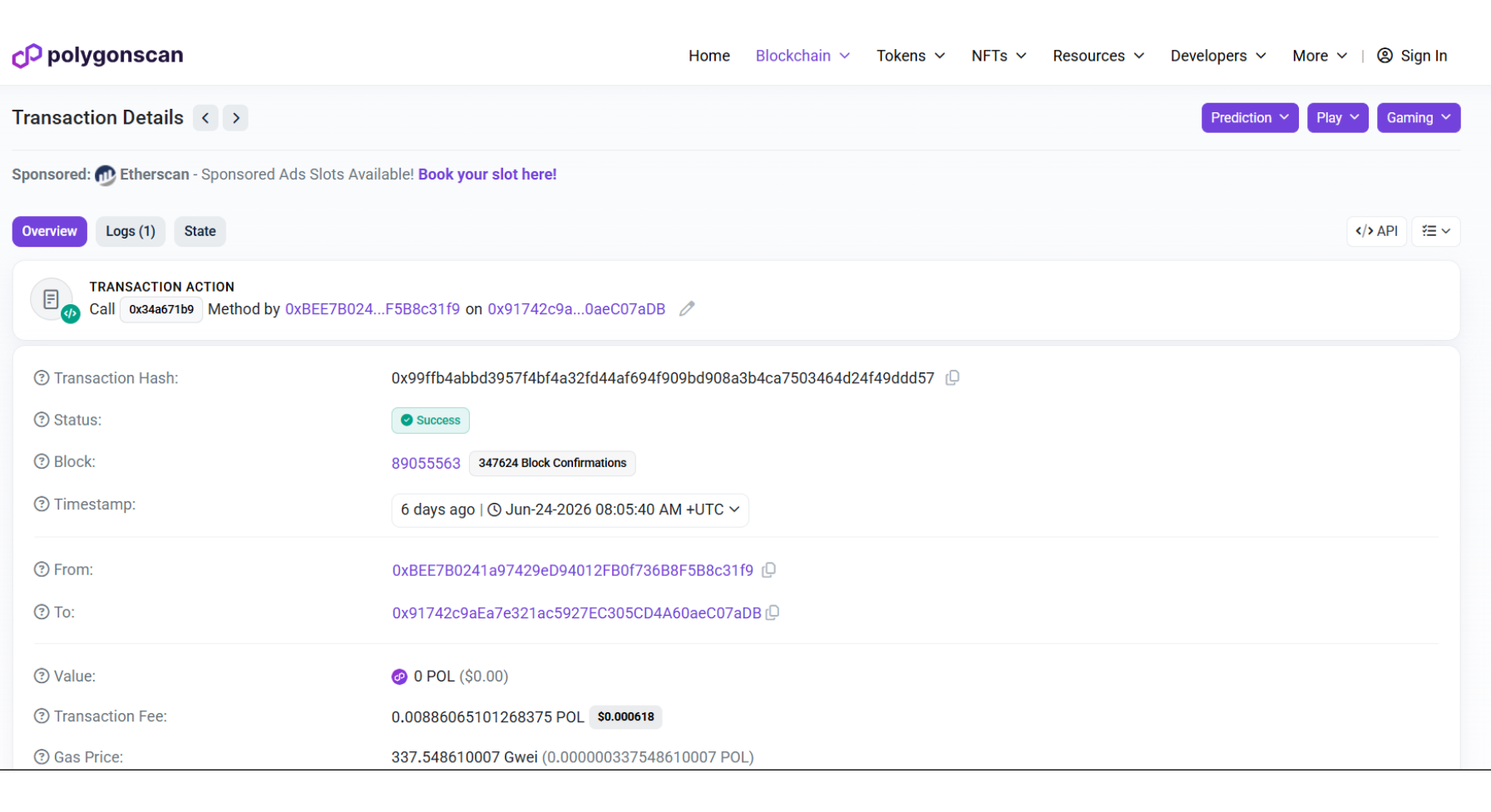
A verifiable RFI certificate is generated with a public Polygon transaction hash, SHA-256 document integrity proof, and a full immutable event trail — searchable on any block explorer, available for regulatory review at any time.
This isn't a PDF report. It's a permanent, tamper-proof record anchored to the Polygon blockchain — with a public transaction hash any counterparty, auditor, or regulator can independently verify. Documents are never stored on-chain. Only their cryptographic SHA-256 hashes are recorded — giving regulators the verifiability they require, while preserving the confidentiality your clients expect.
Immutable audit trail

Every document request, submission, and response is recorded on Polygon PoS Mainnet — creating a tamper-resistant record available for audit and regulatory review at any time, by any authorized party.

Structured RFI workflows
Standardized request and response templates replace fragmented email exchanges, reducing back-and-forth and accelerating resolution. Every case follows a consistent, auditable process.

Secure document exchange
Encrypted document transmission between verified institutional counterparties ensures confidentiality and integrity. Documents are never exposed on-chain — only their cryptographic hashes are recorded.

Real-time status visibility
Compliance teams gain immediate visibility into the status of every request — flagged, submitted, verified — eliminating the need for manual follow-up and reducing settlement delays.

White-label ready
Compliance-RFI under your own brand as part of your institution's compliance infrastructure stack. Full API access and customisable workflows for integration with your existing systems.

Built for ASEAN market
ASEAN comprises ten markets and ten regulatory regimes. Compliance-RFI was built by a MAS-licensed MPI operating under the same AML/CFT expectations it helps clients address — not retrofitted from a Western compliance model.
Managing large volumes of cross-border payment RFIs and needing a structured, verifiable channel that satisfies correspondent relationships.
Seeking a structured and auditable channel for compliance documentation that meets regulatory expectations.
Strengthening compliance infrastructure to support correspondent relationships and regulatory reviews as transaction volumes grow.
Looking to reduce operational overhead, improve audit readiness, and replace manual email-based workflows with a blockchain-verified process.
Compliance-RFI is Moolahgo's blockchain-powered platform for compliance document exchange between financial institutions. It enables banks, licensed payment institutions, and fintech operators to send, receive, and track Requests for Information (RFIs) and supporting compliance documents through a secure, structured channel — replacing manual email-based workflows with an immutable, auditable process built on Ethereum Layer-2 (Polygon).
Blockchain provides an immutable, time-stamped record of every document interaction — who sent what, when, and whether it was received and acknowledged. Unlike email or manual logs, which are vulnerable to loss, alteration, or inconsistency, Compliance-RFI's on-chain audit trail satisfies regulatory review requirements and is independently verifiable by any counterparty with the transaction hash — without exposing the underlying documents.
Ethereum Layer-2 refers to a secondary processing layer built on top of the Ethereum blockchain. It inherits Ethereum's security and immutability while offering faster transaction speeds and significantly lower costs — making it practical for the high-frequency document exchange that compliance operations require. Compliance-RFI runs on Polygon PoS Mainnet, one of the most battle-tested Ethereum Layer-2 networks.
Yes. Compliance-RFI is white-label ready, allowing financial institutions and payment providers to deploy the platform under their own brand as part of their compliance infrastructure stack. Contact our team at sales@moolahgo.com for integration enquiries.
Moolahgo is licensed by the Monetary Authority of Singapore (MAS) as a Major Payment Institution under the Payment Services Act. Compliance-RFI is built and operated within Moolahgo's MAS-regulated framework — meaning the platform reflects the same compliance standards Moolahgo operates under, extended to the broader market.
The platform is designed for banks, correspondent banking networks, licensed payment institutions, fintech operators, and compliance teams across ASEAN that need a structured, auditable channel for cross-border compliance documentation.
Compliance-RFI is designed to complement, not replace, existing compliance processes. It provides a structured overlay for the document exchange component of RFI workflows, with real-time status tracking and on-chain logging that integrates with your team's existing review and approval processes. For integration enquiries, contact our team at sales@moolahgo.com.
Use this glossary to understand the key compliance, audit, blockchain, and payment terms used in Compliance-RFI, Moolahgo’s blockchain-anchored document exchange for regulated financial workflows.
| A to C |
AML/CFT — Anti-Money Laundering and Countering the Financing of Terrorism controls used by regulated institutions to detect, prevent, and report suspicious financial activity. Audit Trail — A chronological record showing when documents, requests, submissions, reviews, and approvals occurred, helping institutions demonstrate accountability and regulatory readiness. Blockchain-Anchored Record — A digital record linked to a blockchain through a cryptographic proof, providing verifiable evidence of the record's existence, timing, and integrity. Compliance-RFI — A secure platform for exchanging compliance documents and responses to information requests, designed to create verifiable, tamper-proof audit trails for financial institutions and partners. Correspondent Banking — A banking arrangement where one financial institution provides services on behalf of another financial institution, typically across different countries. Correspondent banking enables cross-border payments, foreign currency transactions, trade finance, and access to local banking networks when a financial institution does not have a direct presence in a particular market. Cryptographic Proof — A mathematically generated proof that helps verify whether a document or transaction record has remained unchanged since it was created or submitted. |
|
| D to I |
Document Exchange — The secure submission, receipt, review, and storage of documents required for compliance, regulatory, or transaction verification purposes. Ethereum Layer-2 — A scaling network built on top of Ethereum that improves transaction speed and cost efficiency while retaining the security benefits of the underlying blockchain ecosystem. Financial Institution — A regulated organization such as a bank, payment institution, remittance provider, e-wallet operator, or fintech company that provides financial services. Hash — A unique cryptographic fingerprint generated from a document, file, or data set. Even a small change to the content produces a different hash value, making hashes useful for verifying document integrity, detecting tampering, and creating blockchain-anchored proof of record authenticity. Immutable Record — A record that cannot be altered without leaving evidence of change, supporting stronger trust, traceability, and dispute resolution. Institutional Compliance — The policies, controls, documentation, and reporting processes that regulated organizations use to meet legal, regulatory, and partner requirements. |
|
| K to R |
KYC — Know Your Customer checks used to verify a customer’s identity and assess compliance risk before or during a financial relationship. On-Chain Timestamp — A blockchain-recorded time reference showing when a document exchange, submission, or transaction proof was created. Proof of Transaction — Verifiable evidence that a transaction, request, or document exchange occurred, including when it happened and what information was associated with it. Regulatory Readiness — The ability to provide accurate, complete, and timely evidence to regulators, auditors, or banking partners when requested. Request for Information (RFI) — A formal request for additional information or supporting documents, commonly used by banks, payment providers, and regulators to clarify transaction or customer details. |
|
| S to W |
Secure Portal — A controlled digital environment where authorized users can submit, review, and manage sensitive compliance documents. Tamper-Proof — Designed so that unauthorized changes are either prevented or made detectable, helping preserve confidence in records and evidence. Tokenized Deposits — Digital representations of commercial bank deposits recorded on a blockchain. They enable faster and more efficient payments while remaining backed by regulated bank deposits, combining blockchain technology with the safety and oversight of the traditional banking system. Verifiable Audit Trail — An audit trail supported by independently checkable evidence, helping institutions confirm document history, submission timing, and record integrity. White-Label Platform — A technology platform that can be branded and deployed by another financial institution or partner as part of its own compliance workflow. |












Join financial institutions across ASEAN using Compliance-RFI to replace email-based compliance workflows with a blockchain-verified audit trail.