
QR Scan & Pay: Why Southeast Asia’s Cashless Future Runs on QR Codes
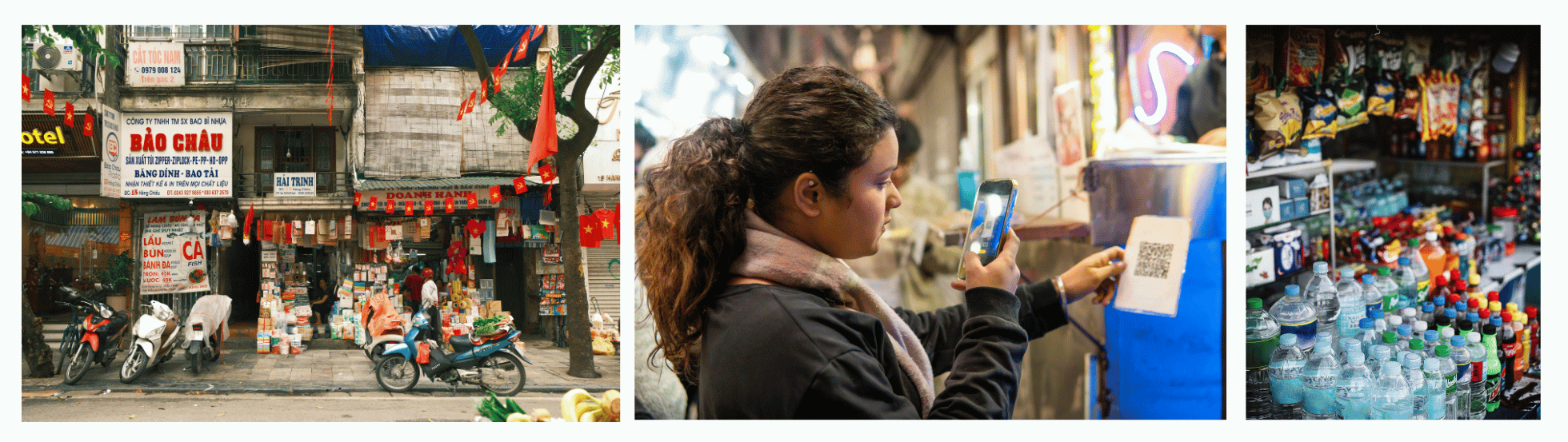
Walk through a market in Hanoi or a sari-sari store in Manila today, and you’ll likely see the same thing: a small printed QR code taped to the counter. Across Southeast Asia, QR codes have quietly become one of the most widely used ways to pay — faster than cash, often cheaper for merchants than cards, and increasingly interoperable across banks, e-wallets, and borders.
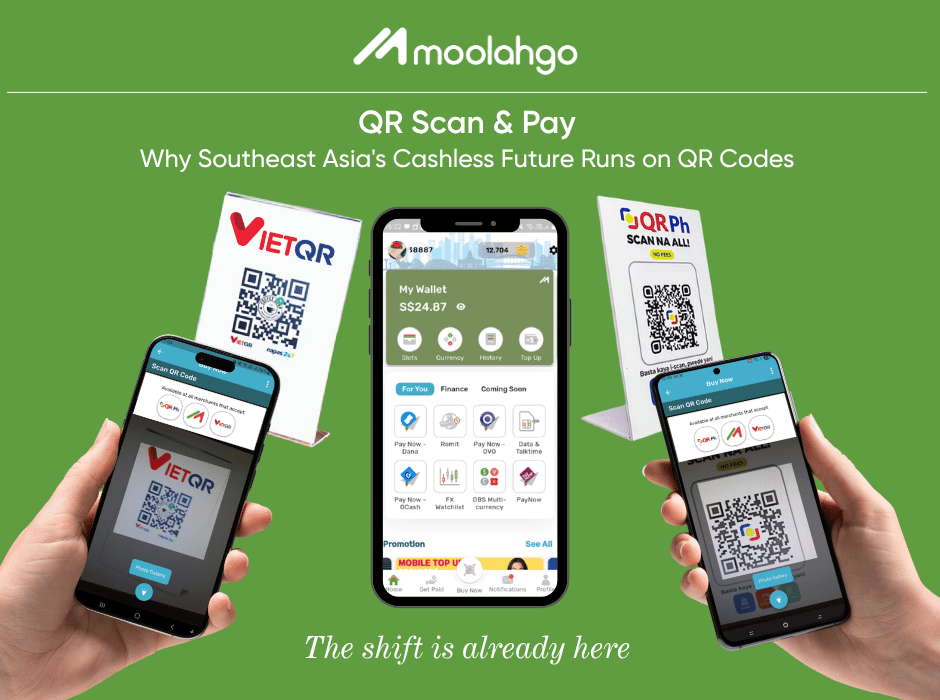
This shift isn’t accidental. Governments and central banks across the region have been racing to build national QR standards that let any participating bank or e-wallet scan a single code, as part of an ASEAN push for greater financial inclusivity1. Vietnam has VietQR. And the Philippines is rolling out QR Ph, mandated by the Bangko Sentral ng Pilipinas as the country’s national interoperable QR standard, built on the global EMVCo framework.
For consumers, this means one less wallet to carry. For travelers, freelancers, and migrant workers sending money home, it means fewer fees and less friction. And for financial institutions, it raises an obvious question: how do you plug into all these local standards without building separate integrations for every market?
This article looks at why QR-based payments have become the backbone of cashless adoption in Southeast Asia, the practical problems that fragmented QR ecosystems create for both consumers and financial institutions, and how Moolahgo is addressing this through both its consumer e-wallet, moolahPAY, and its white-label payment infrastructure for other FIs.
Why QR codes won Southeast Asia’s payments race
It’s worth reflecting on why QR took off in this region specifically, rather than tap-to-pay cards or other contactless methods that dominate in markets like the US or Western Europe.
The answer is largely structural. Card infrastructure — point-of-sale terminals, acquiring banks, card network fees — is expensive to roll out and maintain, particularly for small merchants. A huge share of economic activity in Vietnam, the Philippines, Indonesia, and elsewhere happens through micro and small businesses: market stalls, sari-sari stores, street food vendors, family-run shops. These merchants often can’t justify the cost of a card terminal, but a printed QR code costs almost nothing beyond a piece of paper.
Central banks noticed the pattern and moved to standardize it. Rather than letting every bank and wallet provider issue incompatible QR formats, and forcing merchants to display a dozen different stickers, regulators built unified national standards. The logic is the same one that underpins interbank payment rails: one format, many participants, lower friction for everyone.
Why QR codes won Southeast Asia’s payments race
VietQR is Vietnam’s interbank QR payment standard, developed by the National Payment Corporation of Vietnam (NAPAS) in coordination with the banking sector. It allows a single QR code, whether printed at a merchant counter or generated dynamically at checkout, to be scanned by any participating Vietnamese bank app or compatible e-wallet, with funds settling into VND accounts in near real time. It is increasingly common at retail counters, restaurants, and for peer-to-peer transfers across the country.
QR Ph is the Philippines’ equivalent, mandated by the Bangko Sentral ng Pilipinas (BSP) as the national interoperable QR standard and built on the global EMVCo QR specification. Where Vietnam’s QR ecosystem matured somewhat organically before being standardized under VietQR, the Philippines has taken a more top-down approach — requiring banks and e-money issuers to adopt QR Ph as part of the BSP’s broader digital payments transformation roadmap. The intent is for the same outcome: a single, interoperable QR code that works regardless of which bank or wallet a customer or merchant uses.
Both standards point in the same direction that’s playing out across the region: QR is no longer a feature one wallet offers as a differentiator. It is becoming essential payment infrastructure, similar to how interbank transfer rails became invisible utility once they matured.
The pain point: fragmented QR ecosystems
Despite the push toward standardization within each country, the experience still breaks down the moment payments need to cross a border — and that’s where the real friction sits today, for both consumers and financial institutions.
For consumers and travelers
For everyday users, the problem is simple — your home e-wallet doesn’t speak the local QR language. A traveler from Singapore landing in Ho Chi Minh City or Cebu can’t just scan the merchant’s QR code with their usual app. VietQR and QR Ph were built for domestic interoperability, not cross-border use, so in most cases — especially in markets like Vietnam and the Philippines — a foreign wallet isn’t part of the equation by default.
In practice, this leaves travelers with a familiar set of bad options: changing cash at unfavorable airport rates, hunting for an ATM that accepts a foreign card and charges a withdrawal fee on top of a poor exchange rate, or downloading a local e-wallet app just for the duration of a short trip — often requiring local ID verification or a local bank account that a tourist simply doesn’t have.
The same friction shows up for freelancers, remote workers, and migrant communities who need to send or receive money tied to one of these currencies but don’t hold a local bank account. Every extra step — every conversion, every app download, every fee — makes what should be a simple transaction more complicated.
For financial institutions
The challenge is structurally bigger for banks, e-money issuers, and other financial institutions that want to offer cross-border QR payments to their own customers.
Each national QR standard comes with its own technical specifications, message formats, settlement rails, and regulatory requirements. Connecting to VietQR isn’t the same engineering or compliance exercise as connecting to QR Ph — different central bank requirements, different participating bank networks, different certification processes. Multiply that across every market an FI might want to serve, and the result is a long, expensive integration roadmap before a single transaction can flow.
For smaller or mid-sized FIs without large in-house payments engineering teams, this is often enough to shelve the idea entirely — even when there’s clear customer demand for cross-border QR payments. The opportunity cost is real: customers who want to pay merchants in Vietnam or the Philippines the way locals do will simply look elsewhere, often to a competitor or a standalone wallet app, rather than wait for their primary FI to catch up.
Moolahgo’s approach: one wallet, multiple QR standards
Moolahgo, a Singapore-based, MAS-licensed Major Payment Institution, has been building toward exactly this kind of interoperability — solving the cross-border QR problem once, at the infrastructure level, rather than leaving each FI or consumer to solve it on their own.
On Moolahgo’s consumer e-wallet, moolahPAY, users can now scan and pay using VietQR and QR Ph at supported merchants in Vietnam and the Philippines respectively. A user tops up their wallet in SGD, and at the point of payment, Moolahgo handles the currency conversion and settlement so the merchant receives VND or PHP directly — no need to carry local cash, hold a Vietnamese or Philippine bank account, or download a separate local app. The exchange rate is applied at the point of transaction using near real-time rates designed to be competitive, which matters for anyone making frequent or sizeable payments while traveling, working, or doing business in Vietnam or the Philippines.
The recent addition of QR Ph to moolahPAY extends this capability into the Philippines, giving users the same scan-and-pay experience already available through VietQR in Vietnam. Users can top up once in SGD, scan a QR Ph code at a participating merchant, and pay directly in PHP while Moolahgo manages the conversion and settlement behind the scenes.
The principle behind both integrations is the same: rather than asking the user to adapt to each country’s payment ecosystem, the wallet adapts to wherever the user is.
Beyond the wallet: white-label QR scan & pay for FIs
The same QR scan and pay infrastructure that powers moolahPAY is also available to other financial institutions as a white-label solution — which is arguably where the bigger structural opportunity lies.
Rather than each FI independently navigating the technical and regulatory requirements of VietQR, QR Ph, and other national QR standards, Moolahgo’s infrastructure allows partner FIs to plug into this connectivity directly and offer their own customers QR-based cross-border payments under their own brand. The FI doesn’t need to build settlement relationships with NAPAS-aligned banks in Vietnam or navigate BSP certification for QR Ph independently — that integration work is handled within Moolahgo’s infrastructure, including FX handling, settlement routing, and compliance layers required for cross-border transactions.
This matters because the direction of travel across ASEAN is clear: interoperable QR payments are becoming the default, not the exception, for both domestic and cross-border transactions. As more central banks formalise national QR standards and look toward linking them regionally — following the model already being explored for cross-border QR interoperability between countries like Singapore, Thailand, and Indonesia — the FIs that already have this infrastructure in place will be better positioned to move quickly, while others are still scoping their first integration.
For an FI evaluating whether to build this capability in-house or work with an infrastructure partner, the calculus typically comes down to time-to-market and ongoing compliance overhead. Each additional QR standard added to an in-house build means more regulatory relationships to maintain and more system updates to track as standards evolve. A white-label model shifts that maintenance burden to the infrastructure provider, letting the FI focus on its own customer relationship and product experience.
What this means going forward
As QR Ph adoption accelerates in the Philippines and VietQR continues to mature in Vietnam, FIs and wallets that can deliver the seamless, familiar payment experiences customers increasingly expect, will have a real edge. Customers and travelers increasingly expect to pay the way locals do, wherever they are, and that expectation isn’t going away as digital payment adoption deepens across the region.
Moolahgo’s combination of a consumer-ready e-wallet and white-label infrastructure is built around that shift: fewer wallets, fewer conversions, and a payment experience that simply works, wherever the QR code is. Whether that means a traveler scanning a market stall’s QR code in Hanoi, or a partner FI extending QR Ph payments to its own customers in Manila without building the connectivity from scratch, the underlying goal is the same — making cross-border QR payments as seamless as the domestic ones that customers already take for granted.
Click here for the moolahPAY VietQR FAQ and here for the QR Ph FAQ.
If you’d like to discuss white-labeling QR Code Scan and Pay for your organization, please email sales@moolahgo.com